
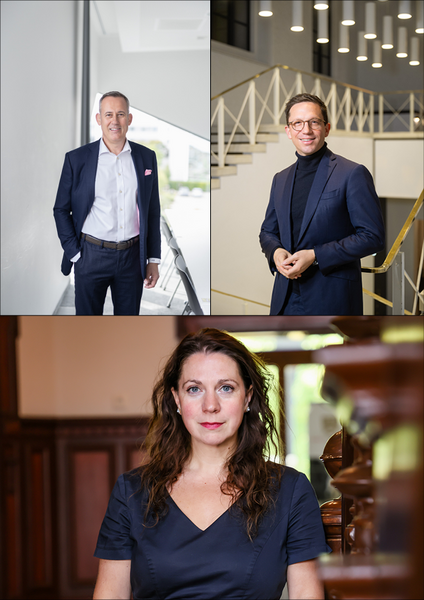
Falk-Martin Drescher: The Braunschweig International Film Festival is celebrating its 40th edition this year. What does this anniversary mean to you—for the festival, but also for Braunschweig and the region?
Maria-Rosa Berghahn: Forty years is far more than just an anniversary. It’s a piece of this city’s cultural history. Over four decades, the BIFF has changed time and again, yet it has remained true to itself: it creates space for cinematic art, discoveries, and encounters. For Braunschweig and the region, it’s a cultural flagship. For us as a foundation, it’s especially wonderful to see how an idea can grow into something enduring over the course of decades.
Anthony Bandmann: The film festival has now established itself as a permanent fixture for international cinematic art in Germany. The developments of the past decades show that even smaller cities can become cultural “hidden champions.” The festival is now a fixture on Braunschweig’s cultural calendar and continues to delight people in the region and across the country year after year.
Falko Mohrs: Forty years of BIFF is an impressive success story. The festival has made a name for itself far beyond the region. It opens up new perspectives and combines local roots with international exchange. For Braunschweig, it’s a wonderful example of how high-quality cultural offerings find their audience and can, to some extent, shape a region. What does culture achieve that other areas of our society cannot?
Maria-Rosa Berghahn: Culture can lead us out of our habitual ways of thinking. It doesn’t have to offer an immediate solution—
—sometimes it’s enough to ask a question that stays with us. A film can, for two hours, open our eyes to the perspective of someone we might never encounter in real life. This ability to foster empathy and imagination is a unique social power of culture.
Anthony Bandmann: For me personally, culture opens up an emotional gateway to our society. This often allows different perspectives to be conveyed more effectively than through facts alone. Above all, it creates shared experiences that connect people across different backgrounds.
Falko Mohrs: Culture creates spaces where we can engage with ourselves and the world around us. It enables shifts in perspective, fosters identity, and opens up access to topics we might otherwise rarely encounter. Artists can express themselves and their view of the world in ways that proposals, speeches, or panel discussions cannot. Art can move and challenge us; it can be both unambiguous and ambivalent at the same time. This is where its special power for our society lies.
Falk-Martin Drescher: What role does culture play in shaping democracy and our understanding of democracy?
Maria-Rosa Berghahn: Democracy thrives on people who can tolerate different perspectives and engage in dialogue with one another. Culture creates spaces precisely for this purpose. It is allowed to provoke, contradict, and even be uncomfortable. A vibrant cultural landscape is therefore not a luxury of a democratic society, but part of its infrastructure.
Falko Mohrs: A vibrant democracy is inconceivable without a vibrant culture. Culture is a central hub for social exchange, openness, and diversity. In doing so, it fulfills two functions that only appear contradictory at first glance: It fosters community and identity, while at the same time continually challenging the status quo. Culture should spark debates, bring conflicts to light, and open up new perspectives. It is precisely this ability to bring people together while simultaneously challenging them to reflect that makes culture indispensable to a free and democratic society.
Anthony Bandmann: Democracy thrives on our ability to recognize, tolerate, and discuss—and perhaps even debate—different viewpoints. Cultural exchange is fundamental to this. It encourages us to question existing ideas and fosters openness and a willingness to see things from a different perspective.
Falk-Martin Drescher: Every year, the BIFF brings together filmmakers, industry professionals, and a large audience. What significance do such places of encounter hold today—especially at a time when so much takes place digitally and is increasingly individualized?
Falko Mohrs: Precisely because so much takes place digitally, places for personal encounters are becoming increasingly important. Film festivals have the unique ability to create a unifying experience through the films. People engage in conversation with one another about what they’ve seen, discuss it, and in doing so gain exposure to new perspectives. Such encounters strengthen social cohesion and cannot be replaced by digital formats.
Maria-Rosa Berghahn: Digitally, we can connect with almost anything—but a connection isn’t the same as an encounter. A festival like BIFF creates that special moment when people watch a film together, laugh, get annoyed, discuss it, and perhaps even change their minds. Such analog experiences are more valuable today than ever before.
Anthony Bandmann: Digital streaming services and media libraries shape the daily lives of most people these days. As a result, access to film culture is broader than it used to be. However, this access can also be very one-sided if one focuses exclusively on the biggest blockbusters and the most successful series. For me, such offerings are no substitute for personal interaction. Festivals like BIFF facilitate shared experiences and direct exchange between filmmakers, industry professionals, and audiences. This strengthens social cohesion, and that’s especially important today.
Falk-Martin Drescher: In your view, what role does culture play in the appeal of a business and research hub like Braunschweig and Lower Saxony?
Anthony Bandmann: An attractive location needs more than just good jobs, affordable housing, recreational areas, and an efficient transportation infrastructure. A strong cultural infrastructure significantly enhances quality of life and fosters a sense of belonging to a region. A diverse cultural offering helps attract skilled workers, retain talent, and further shape Braunschweig as a cosmopolitan location.
Maria-Rosa Berghahn: A region isn’t made attractive solely by jobs, infrastructure, or research institutions. People also ask themselves, “
, how do I want to live here?” Culture creates identity, quality of life, and openness. A scientific and economic hub like Braunschweig, in particular, needs places where diverse people and ideas can come together. Culture is therefore not a peripheral location factor, but rather an integral part of a location’s quality. The two thus go hand in hand.
Falko Mohrs: A strong hub for science and business also needs a vibrant cultural environment. Skilled workers, researchers, and students don’t choose a place just because of a job or a university. They also look at how open, diverse, and livable a region is. Culture contributes significantly to quality of life and makes our cities and regions attractive, innovative, and sustainable.
Falk-Martin Drescher: Supporting culture is also a form of social engagement. What can or should the public sector do—and what responsibility do companies, foundations, and private sponsors have?
Anthony Bandmann: What’s crucial is a shared commitment that preserves the independence of culture in terms of content. The public sector creates reliable framework conditions, thereby enabling cultural diversity. Companies and private sponsors complement this commitment through long-term partnerships, thus opening up additional opportunities.
Maria-Rosa Berghahn: The public sector bears a special responsibility to ensure that cultural diversity and cultural participation do not depend solely on economic viability. At the same time, culture can only remain diverse in the long term if many people take on responsibility. Companies, foundations, and private sponsors can create space for creativity, enable innovation, and forge long-term partnerships. It is crucial that we support culture not only when it is already successful, but also where new ideas are just beginning to take shape.
Falko Mohrs: The public sector has the responsibility to safeguard cultural infrastructure and enable cultural participation for everyone. Culture must not be dependent on financial means. At the same time, the state and local governments face the challenge of sustainably maintaining cultural infrastructure and addressing the significant need for renovation at many institutions. Civil society engagement is therefore invaluable. Companies, foundations, and private sponsors
support numerous institutions throughout Lower Saxony. Wherever public funding and civic engagement come together, particularly strong and sustainable projects often emerge.
Falk-Martin Drescher: In addition to major productions, the BIFF also screens many films that might otherwise not reach a large audience. How important are such cultural spaces for new perspectives and social discourse?
Falko Mohrs: They are indispensable. Festivals like the BIFF provide a stage for voices and stories that are often less visible in the mainstream. This creates new impetus for social debates and fosters a better understanding of the realities of life for different people.
Maria-Rosa Berghahn: These spaces are very important. Culture doesn’t always have to reinforce what we already know. It’s precisely the lesser-known films that can shed light on perspectives that otherwise receive little attention. That’s valuable both culturally and democratically. A good festival therefore doesn’t just provide answers; it broadens our horizons—sometimes very quietly, sometimes with great force.
Anthony Bandmann: I would also say that such cultural spaces are indispensable. They provide a stage for young talents with unconventional perspectives. It is precisely this diversity that broadens our outlook and facilitates discussions that would otherwise receive less attention—including those across generations.
Falk-Martin Drescher: If you look ten years into the future: What role should culture play in Braunschweig and Lower Saxony—and what do we need to do today to make that happen?
Maria-Rosa Berghahn: I hope that in ten years, culture won’t be viewed as something you can afford only once everything else is taken care of. It is a fundamental pillar of an open society and, therefore, of our democracy. To achieve this, we must invest today in institutions, in artists, in cultural education, and above all in spaces for creative freedom. Our goal should therefore be to leave the next generation a cultural landscape that is just as diverse and vibrant as the one we ourselves found—and, in the best-case scenario, perhaps even more diverse. And we must maintain the courage to support even those initiatives whose success we cannot yet foresee.
Anthony Bandmann: Culture should continue to play a central role in a vibrant and open society ten years from now. To achieve this, we need reliable structures, cultural education, suitable creative spaces, and the courage to embrace new formats today. Above all, we must reach young
people early on and enable them to experience culture and help shape it themselves.
Falko Mohrs: My hope is that in ten years, culture will be perceived even more strongly as an integral part of our social life—that it will be accessible, diverse, and present throughout Lower Saxony. To achieve this, we must set the right course today by preserving existing structures and conveying the value of culture to people through low-threshold programs. Culture is not just a “nice-to-have.” It is a central prerequisite for social cohesion, creativity, and democratic participation.