
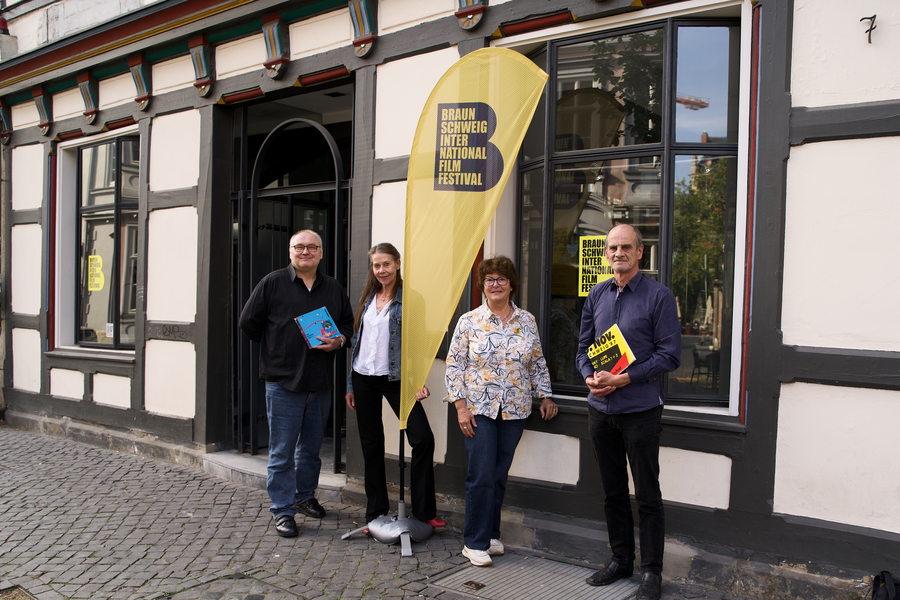
Peter Wentzler (Founding Member)
Clemens Williges (Member since 1995)
Kirsten Schult (Member since 2014)
Katrin Mosel (Member since 2023)
Morten Langmeier (Member since 2026)
The curation of our “Over 40” series is complete. The concept was to bring to life the evolution of the film festival and the Filmfest Association through five personal favorites spanning five decades. The special twist: We each chose a film that screened at an edition of the festival when we were part of the audience and not yet involved in shaping the program. Of course, that doesn’t apply to you as a founding member, Peter. What was it like back then when you got together with 19 other film enthusiasts to start a film festival for the Braunschweig audience? And why did you BANKET FOR ACHILLES (1975), which screened at the 3rd Film Festival, for our series?
Peter: Robert Heinemann and I were part of the FilmKooperative Braunschweig. An association that, since the 1970s, had been screening films that documented social conflicts—serving as a forum for alternative public discourse with many discussion events (the anti-nuclear movement, Greenpeace, the Third World, the Nazi era…). Then, in 1985–86. The FilmKoop was also asked if we wanted to join the effort to found a film festival. Of course. I think Frank Oppermann and Harry Binder came up with the idea. Film students from the HBK, people from the TU Cinema, journalists, and other film enthusiasts joined in. Many of us had known each other for quite some time, and with Frank and the cinemas he managed, the infrastructure was already in place. That made things much easier, allowing us to focus on the program. The participants had many different interests and preferences, which came together to form the first festival program—a film festival. Robert and I also had our own specific interest—our curiosity about the “real” living conditions of people in the GDR, as close to everyday life as possible. We hoped the films would give us some insight. That’s how the idea for the DEFA retrospective series “Films from the GDR” came about. It was actually quite obvious for a city so close to the border. Politically, tensions between East and West were at a peak. Gorbachev’s “glasnost” unsettled the GDR government. Then came the Chernobyl disaster—in short, the world’s gears were grinding. We made direct contact with our first guest, Lothar Warnecke, and invited him to Braunschweig. To our pleasant surprise, he came to the festival with his wife, Waltraut. It was an all-around successful event—our nights at Café Kollontay remain unforgettable. In 1988, director Rainer Simon was our guest. In 1989, we introduced director Roland Gräf, whose film *Banquet for Achilles* .
He came to Braunschweig accompanied by his wife Christel, a renowned dramaturg, and Jutta Wachowiak, an equally renowned film and theater actress. Another unforgettable moment this time: During our festival, the Berlin Wall and the border near Helmstedt opened, and Braunschweig was practically overrun by citizens from the GDR. And on the Kohlmarkt, prominently displayed at the Scala Cinema for them to see: “Films from the GDR — Roland Gräf Retrospective.”
’S “ACHILLES” BANQUET made a lasting impression on me. Filmed on location with as many people as possible from the factories in Bitterfeld and Wolfen. Erwin Geschonneck shines in the role of the gruff Achilles, who can’t bring himself to accept that he’s being forced into retirement. And deep down, he wants to finally make it happen so that blue flowers bloom again on the slag heaps—the waste products of his own labor!
Clemens: The “Films from the GDR” series aired for the last time in 1990. The following year, I discovered the film festival for myself. Back then, it had a completely different program structure than it does today. When looking through the catalog of the 5th Filmfest, the diversity of retrospective screenings and thematic series immediately catches the eye, while contemporary German and international cinema—with only six and twelve films, respectively—made up a much smaller portion of the program than they do today.
, I focused on “PreNoir” and the “Night Specials.” Films like WACHTMEISTER STUDER (1939) or BLUT FÜR DRACULA (1965) were new to me, but they tied in with my previous cinematic experiences. Then, however, I experienced PHASE IV (1974) as part of “A Tribute to Saul Bass.” I was just 20 years old at the time and completely overwhelmed by the images on the screen. The television of the 1980s hadn’t prepared me for this experience. Thirty-five years later, the cinematic fusion of sci-fi, horror, and visual art is still one of a kind.
Kirsten, you joined the association twelve years ago. But as a visitor, you’ve been connected to the film festival for much longer. How did you come to choose SILENT LIGHT (2007) from the 22nd Film Festival?
Kirsten: As an avid Filmfest season-ticket holder, I’d already been attending regularly for four years at that point—and for 23 years now, the Filmfest has held a special and significant place in my life. SILENT LIGHT, which is set among the Mennonites in Mexico, left a lasting impression on me: The introduction mentioned that you could almost immerse yourself in this film in a meditative way. The six- to eight-minute sunrise sequence at the beginning is magnificent and, for me, remains one of the most impressive film sequences ever—
. Eighteen years later, I’m looking forward to experiencing this modern classic of world cinema once again on the big screen with our wonderful audience.
Katrin, although you’ve only been with the Filmfestverein since 2023, you’ve actually been attending the BIFF for much longer. You’ve selected the HEINRICH Award winner from our 30th edition, which took place ten years ago. Is *THE PARADISE SUITE* (2015) even more relevant today than it was back then?
Katrin: I’ve always been interested in cinema, and I’ve tried to see as many films as possible at BIFF. Ever since the 32nd BIFF, I’ve taken a week off work and used my season pass to see as many films as possible from the Main Competition and New International Cinema sections. THE PARADISE SUITE was one I particularly enjoyed. I’d snagged one of the last seats in the front row and was overwhelmed by the film’s power. It’s not light viewing; thanks to the excellent acting and stunning cinematography, the protagonists’ fates are deeply moving. The themes are, unfortunately—and I mean unfortunately—still relevant today, or perhaps even more so now. The film is from 2015, the year of the refugee crisis, when refugees were welcomed. Today, xenophobia is practically being made socially acceptable, which worries me and fills me with shame. Films like THE PARADISE SUITE show that migration is a complex issue and that understanding people’s plights is essential.
Morten, you recently joined the association. What do you find particularly appealing about *ZILLION* (2022), which screened at the 37th BIFF? Did it inspire you to get involved in programming?
Morten: After the COVID-19 pandemic, I attended film festivals with a friend so intensively that we took advantage of every single screening without exception. The film selection, the guests, and the atmosphere thrilled us. In particular, being able to watch films that didn’t make it to Germany—or at least not to the theaters in Braunschweig—was a draw that motivated me to get involved. The fact that I now get to screen cinematic gems and present my favorites is, of course, the best part. ZILLION is an excellent example of this. The film wasn’t shown in any movie theater here—I even had to order the DVD from abroad. It’s all the more wonderful that it’s now back on the big screen. I was blown away for two hours. ZILLION is absurd and thrilling. With a relatively small budget, it features magnificent scenes that can rival Hollywood’s and prove once again: creative vision reigns supreme. Given the decline of clubs and the loss of sociocultural gathering places, the film also takes on special relevance.
Let’s round up five favorites from the 40th BIFF.
Kirsten: In *THE SEA*, we follow 12-year-old Khaled from Palestine, who is desperate to finally see the sea. Unfortunately, it’s in Israel. Even worse: during a school field trip, he’s denied entry at the border. On the spur of the moment, he sets out illegally on foot on the dangerous journey. Human—moving—absolutely worth seeing. And the documentary AMONGST THE BIRDS is not to be missed: We travel to a secluded fjord in Iceland and meet 12,000 eider ducks and five adults. Stunning imagery, seasoned with wonderful, dry Nordic humor.
Morten: In the fantastic THE ALTAR BOYS , four young altar boys decide to redistribute their church’s collection more fairly, Robin Hood-style. However, their actions aren’t always morally sound. Also airing is the music documentary HEX about the Norwegian black metal band Witch Club Satan, which, like ZILLION , is a true force of nature. Stage performances in demonic costumes and drenched in fake blood clash with an incredible warmth against a backdrop of feminism and female rage.
Katrin: In keeping with the theme of THE PARADISE SUITE , I especially recommend A LOOSE END, in which an Argentine police officer flees to Uruguay to escape his corrupt colleagues. With kindness and cleverness, he tries to build a new life for himself. In sometimes bizarre situations, he meets people who give him a chance. With humanity, kindness, and humor, many things are possible.