
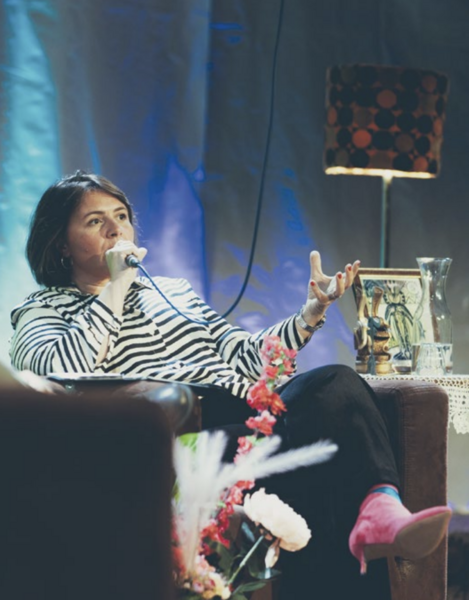
The history of the so-called "guest workers" is a central part of German post-war history - and yet for decades it was only dealt with at the margins of the social narrative. With the GenerationGOLD project, Türkân Deniz-Roggenbuck, founder of the Braunschweig-based agency Kulturton, has created a space that makes these biographies visible.
Türkân, what motivated you personally to launch the GenerationGOLD project?
The project literally fell at my feet while I was jogging in 2021, when I was outraged by the inadequate reporting on guest workers on the 60th anniversary of the German-Turkish recruitment agreement. And also through my own biography - because my grandfather also immigrated as a guest worker and arrived in Munich at track 11.
This heartfelt project is a kind of belated thanks to a generation that has done so much for our country without ever being given the stage or platform they deserve. And they should now be given this visibility as contemporary witnesses whose stories have been marginalized for too long, even though they belong at the heart of our national history.
The very title "GenerationGOLD - Yesterday - Today - Tomorrow | dün - bugün - yarın" shows that it is not just about one chapter of the past. What do you want to make visible with this perspective?
We want to build bridges between the past, present and future. And also to work through and translate the concept of post-migration. Because we as a society as a whole are in a post-migration process - not just people with a migration heritage.
So when we talk about YESTERDAY, we mean the stories of those who experienced active guest worker migration. TODAY stands for the confrontation of subsequent generations and how formative this has shaped our society. TOMORROW focuses on how we want to live together in pluralism and solidarity.
Many of the stories of the first migrant workers were hardly documented for a long time. What criteria did you use to decide which voices and perspectives should be made visible?
We wanted diversity within diversity, different countries of origin, different realities of life, but all connected by the chapter of cross-border migration, who came to a country that was foreign to them with hope, strength and confidence. We bring contemporary witnesses to the stage who are otherwise rarely heard, who are not represented on committees, who are not even asked because their truths and experiences may be uncomfortable. Always under the premise of who is willing to talk and share intimate, vulnerable topics and personal memories. This is also the common thread for the Diversity Salon at the film festival.
Are there any encounters that have particularly moved or surprised you?
There are many - but the ones that touch me the most are people who are strangers to me, regardless of their country of origin, who express their pride or gratitude after events or presentations that I bring these topics to the public and give them a voice. Because the reason they left their homeland was so that the next generation would be better off. Gratitude is a big keyword: these people are simply happy when their realities are told. As a lecturer, I also experience how students often learn for the first time that their migration heritage is appreciated - or that they have a migration history at all. But above all, we should let these people tell their own stories, listen to them and anchor their stories in our collective memory.
You are active with your agency Kulturton not only in Braunschweig, but throughout Germany. What other projects and formats are you currently working on?
I am versatile and work across all sectors: I accompany change processes in organizations, coach for empowerment and help institutions to think and act more transculturally.
In addition to GenerationGOLD and the Diversity Salon, there are many other formats that create an open meeting space and that I have initiated or co-designed myself: LiteraturBAR, TalkTachles, Luft & Liebe, Klipp&Klar Kindersalon, Hausbesetzung, Kombinat der Vulven, das Beste Abendmahl...
The leitmotif is the equal inclusion of communities, institutions and organizations with the aim of creating a non-hierarchical and non-discriminatory space. And I accompany people in the knowledge that everyone is an expert in their own experience. I contribute my knowledge, but those who come to me are also experts in their own way.
Your Diversity Salon has been an integral part of the festival program since 2022. How did this cooperation come about and what is particularly important to you in this collaboration?
It was love at first sight with the festival director Karina! We met for the first time at TILDA, I was a founding member of the TILDA Film Award. We then met to talk about a possible collaboration - now the Diversity Salon, which takes place twice a year, is part of the festival once a year with a focus on media.
We deliberately take up "courageous" topics that have not yet reached the mainstream or open up controversial perspectives. On the one hand, it's about agenda setting, on the other hand it's about cooperation at eye level and cross-networking of the target groups.
Why is film in particular such a strong medium when it comes to visibility, representation and social discourse?
Films and media in general are the communication tools that are most easily accessible to society. Films can have a profound effect even before we get to the explanation. With light, sound and get lost, visible and tangible. Stories on the screen give people faces, voices and emotions. Using the example of migration, this does not become an abstract discourse about "others", but the experience that everyone shares the same basic human needs and is interested in harmonious coexistence.
What impact or resonance do you experience with your projects - locally in Braunschweig, but also beyond?
Local communities feel seen and taken seriously, and I'm also often asked to act as a specialist moderator for cross-cutting topics relating to diversity nationwide - I never get bored! As much positive feedback as I receive from all directions, there is also the flip side, which is not constructively critical, but rather accompanied by fear of losing customary rights (i.e. status, privilege and power). But this brings us back to the topic of "courage": you have to be prepared to broaden your perspective - even in the face of negative feedback. At the same time, this also opens up new perspectives for the other side.
You mentioned the topic of "gratitude". What do you think we as a society owe to the generation of guest workers of that time - and what were they denied?
We owe them our current prosperity: financially, culturally, socially and relationally. People with a history of guest workers have contributed to the country's prosperity. The pluralistic social structure in which we live today is based on this formative foundation stone - it enables us to live together in a very diverse way today.
Even if my colleagues may disagree with me, work and the unequal treatment associated with it should be emphasized. And many people with a history of migrant work were denied recognition - despite giving up their homeland and building a new home. The project aims to finally honor their stories and make this pain visible. This is painful and the project aims to change this by finally acknowledging their stories.
Remembrance work is also future work. What is your vision for a solidary and diverse tomorrow?
I would like to see a tomorrow in which we see differences not as a division, but as a wealth. Diversity doesn't just mean making differences visible, but also showing what we have in common. My wish is that we grow together in such a way that origin and socialization background are less divisive and a real "we" emerges, in which many elements flow into one another and form a common whole.
The interview was conducted by Julia Rutkovska – Coordination of Press and Public Relations.